
Choosing a solar battery size starts with understanding your household, not searching for one standard capacity. Two homes with similar annual electricity use can need very different storage because their routines may place demand at different times. Occupancy, overnight appliances, working patterns, heating, EV charging, and electricity tariffs all change the picture. The most useful sizing method is to create a household energy profile and decide what role storage should perform within it. That produces a capacity target based on real routines rather than a broad household average.
Household size matters, but occupancy patterns reveal more. A four-person household that stays empty through most weekdays may have a different storage profile from a two-person household working from home. Start by marking when people are usually present and when major electrical activity occurs. Then identify which of those periods fall outside strong solar-generation hours. This creates a “storage zone” within the day. Electricity used inside that zone becomes particularly relevant when sizing solar battery storage. Instead of assuming that more residents automatically require a particular battery capacity, this approach connects capacity with actual behavior. It also captures details that annual consumption figures miss, such as late dinners, home offices, early mornings, or regular evening appliance use.
Nighttime demand deserves a separate calculation because several household loads may continue after solar generation has ended. Refrigeration, networking equipment, electronics, heating-related equipment, and other appliances can remain active while occupants sleep. Add the estimated kilowatt-hours used from evening until the next useful solar period. Then include any planned nighttime activities that regularly raise consumption. Anker positions the 5 kWh base capacity of the Solarbank 4 E5000 Pro as sufficient to power a standard UK household through the night, including demanding equipment such as a heat pump. For an individual home, the useful comparison is between that 5 kWh capacity and its measured overnight consumption. This makes battery sizing specific to the household’s own nighttime routine.
An average day can smooth out the exact moments that determine battery size. Instead, identify several recurring household day types. A workday may contain low daytime demand and a busy evening. A home-working day may use more electricity while solar generation is available. Weekends may bring longer cooking sessions, laundry, entertainment, or EV charging. Calculate the storage requirement for each pattern, then note how frequently each occurs. This produces a capacity range rather than an artificial single-day estimate. Real-time monitoring can refine the picture further. Solarbank 4 E5000 Pro works with Smart Meter Gen 2, whose dual-circuit design can monitor the main grid while its second channel can track third-party solar output or provide active circuit overload protection.
Household electricity demand can change substantially when new equipment arrives. An EV introduces charging sessions. A heat pump can create another recurring electrical load. More time working from home shifts consumption into different hours. Rather than simply adding a large margin to the initial battery estimate, create a second energy profile for the household you expect in several years. Solarbank 4 E5000 Pro offers 5 kWh of base capacity and can expand up to 30 kWh. Its modular design allows capacity expansion in five seconds. This provides a useful example of staged sizing: establish the capacity that suits present routines, then retain an expansion path for identifiable changes instead of treating every possible future load as part of the immediate requirement.
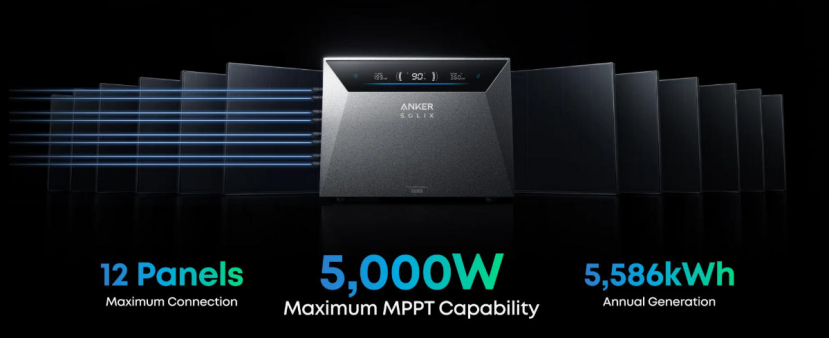
Storage capacity should also make sense alongside the solar system supplying it. Solarbank 4 E5000 Pro accepts up to 5,000 W of solar input, while its four MPPTs support configurations of 4 to 12 panels. Anker states that the supported solar setup can generate up to 5,586 kWh annually under its stated conditions. When evaluating battery size, compare the household’s available solar generation with the amount of energy it intends to shift into later periods. A larger battery becomes meaningful when the wider energy plan can make productive use of that capacity. This connects three household decisions—solar generation, storage capacity, and electricity consumption—without treating battery size as a standalone specification.
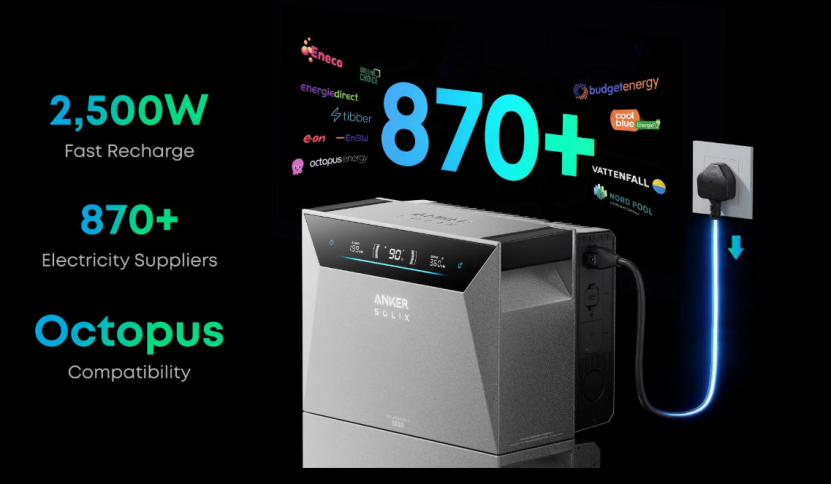
Battery sizing can serve an electricity-price strategy as well as a solar-energy strategy. A household on a variable tariff may want storage available for energy acquired during favorable pricing periods and used later when rates rise. Solarbank 4 E5000 Pro is compatible with Octopus and more than 870 tariffs. With 2,500 W fast recharge, Anker states that its 5 kWh battery can fully charge in under two hours at off-peak rates. This adds another question to the sizing process: how much electricity does the household typically want available during higher-price periods? A capacity that matches this tariff window can perform a different role from one sized mainly around overnight solar use, so the household’s electricity plan belongs in the calculation.
The right solar battery size reflects how a specific household lives, not simply how many people occupy the property. Map occupancy hours, isolate overnight consumption, compare recurring day types, and account for planned electrical changes such as EV charging or heating. Then relate that demand to solar generation and the household’s tariff strategy. This creates a capacity range with a clear purpose, while modular expansion can accommodate future changes without requiring every future energy need to define the initial battery size.
Copyright © 2023 infomorespace.com. All rights reserved.